Hazaaron Khwaishein aisi k har khwahish par dum nikle, bade nikle mere armaan magar fir bhi kum nikle – Mirza Ghalib
This was the first full budget of NDA’s 3rd term. Looking at the history of this government, it is clear they will not favor growth at the expense of fiscal deficit (higher debt). By walking that tight rope, the government delivered to the masses. This comes as a relief. The headline captured it all – “tax deduction for the middle class”.
By estimates this would add around 5% to 7% of incremental disposable income in the hands of the income earners who were struggling with higher inflation and high household debt to GDP. From an economic standpoint, will this be enough?
Expenditure side:
For a while, the biggest contributor to GDP growth has been government spending.
Private capital expenditure and household consumption have been somewhat lackluster. The government has frontloaded all its capital expenditure in building infrastructure, defence spending, upgrading railways, etc. Since April 2020, the government has also helped the private sector through PLI schemes. Barring a couple of industries, PLI schemes have been slowing down. Private sector capital expenditure does not seem to be picking up, which is evident by historical high cash generation by corporates. Nothing in the budget seems to be reversing this trend soon.
There has been some tinkering with the custom duties, where supply chains reside abroad, making it more efficient for the manufacturing sector. Benefits of nuclear power capex will depend on the execution over the course of the next decade. On real estate, there will be no deemed rental income on the second home which is slightly positive.
Revenue side:
Nominal GDP growth estimate for FY 2025 -2026 is 10% which is reasonable. Individuals and households have been contributing more on the direct tax side as compared to corporates. This is when the corporate profit cycle is peaking out. We will have to see if there is any shortfall on the direct tax estimates and whether that shortfall is compensated by indirect taxes. Government will have to do more to rationalize indirect taxes. Every developing nation like India will have higher contribution from indirect taxes compared to direct taxes. Gradually as nations prosper, direct taxes contribute more to the overall tax collections.
To conclude, tax bonanza provided by the government to the masses will help consumption in the medium term and beyond and hopefully incentivize corporates to invest more in capex. This event is behind us now. It was largely in line with what has been delivered by this government historically – fiscal prudence and some amount of populism. There were no negative surprises, which was the biggest positive.
Appendix: (Growth rates of Direct taxes)
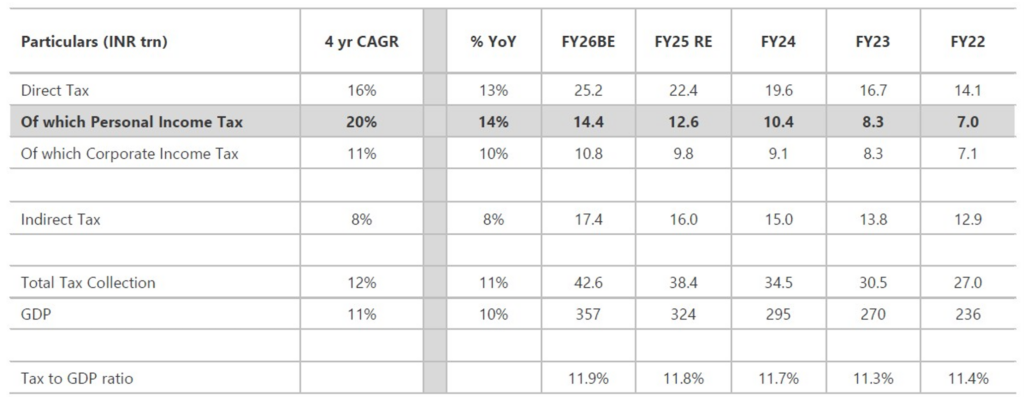
Source: Budget documents, Govt of India